Sunday, June 22, 2008

Another World Exists - Summer Begins in Madison

A few months ago I noted spring was here, another world is possible, and it exists right here in Madison.

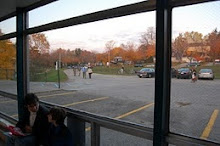
This weekend was the summer solstice, which some people consider the official beginning of summer. My wife and I went to a nice summer solstice (aka Litha) celebration yesterday in Olbrich Park.

There was a bonfire, puppets representing the seasons, organizations with information about things people can do to improve Madison's lakes and streams, and plenty of kids running around playing. Parking contained as many bikes as cars.

If you live in a sprawling community where people commute from homes in one suburb to jobs in another suburb, where people don't know one another and are driven by fear and greed, it's not because of human nature. There are choices about whom you want to live with and how people plan the logistics of their communities. Values of a community reach a critical mass point at which most people go along with them.


Another world is possible, and often you can get to it without a passport.

Friday, June 20, 2008

Debtorship Society Derailed, But Clouded Thinking Persists

The New York Times reports that the percentage of people renting is rising in the wake the of the housing bust.

The article dances around the idea that the bust is reminding people that increasing rates of home debtorship is not a solution to social problems.
Nationally, rents have increased about 11 percent since 2005, when homeownership rates started to decline, though that growth is slowing, according to the Bureau of Labor Statistics.
If these are nominal numbers, it means they've kept pace with inflation. You can go to the Bureau of Labor and Statistics CPI Inflation Calculator and verify this by asking to convert the value of $100 in 2005 into 2008 dollars. It's $111.

That means despite the recent increases in the number of people renting, real rent prices have stayed the same. If there were more people than places to live, we would expect rents to rise. Thanks to the 2000-2006 boom, though, there is a surplus of places to live. That's why the rent price "growth is slowing" while inflation is rising, i.e. real rent prices are falling.

The article mentions a 68 y/o woman with low income, weak credit, and no significant down payment who wanted to buy a house with some friends. She and the non-profit who tried to help her become a homedebtor lament that it was easier to qualify a few years ago. It mentions this after several stories of how going deeply into debt to buy a house destroyed people's lives. The article leaves it to the reader to realize this woman was lucky not be able to get herself into this same situation.
The confluence of factors has largely derailed what Mr. Bush called “the ownership society."
The so-called ownership society is a good idea. A debtorship society is a bad idea. We need to focus on things that help people increase their income and net worth. It's an easier path to get into debt than to improve net worth. The easy path leads to the horror stories in this article. We need to be on the hard path.

Wednesday, June 18, 2008

McCain's Support for Nuclear Power is Right and Good Politics

As President Bush injected himself into the presidential campaign by calling for increased domestic oil drilling, McCain called for developing 45 new nuclear reactors by 2030.

Drilling for more oil is just delaying the inevitable. Nuclear power, on the other hand, will probably become a key source of energy as oil becomes more difficult to extract in the quantities that the world economy requires. My wild guess is that there's less than a 50% chance alternative energies other than nuclear can provide enough energy. It is most likely that alternative energy technologies will be used to store energy produced from nuclear sources.

I wonder whether President Bush and McCain coordinated this. President Bush tried to lay the blame for higher oil prices on Democratic policies. The attacks might draw regressives, who want to pretend like we can keep consuming our present levels of oil indefinitely, toward the Republicans. McCain's comments appeal to some progressives who realize that nuclear power may be the best option. This siphons some progressives away from Obama, whose support for nuclear power is tepid compared to McCain's.

Calls to Expand Domestic Oil Drilling Are Misguided

President Bush's call to expand domestic oil drilling is misguided. Today's high oil prices are an opportunity to develop alternative energies and to improve energy efficiency.

Oil is a finite resource. Alternatives must be found eventually. We should endeavor to transition to alternative energy sources on our own terms rather than struggling to maintain high levels of consumption for as long as possible.

In a crisis, we can always turn to offshore drilling and drilling in ANWR. In the absence of a real energy crisis, our energy policy should be to allow oil prices to remain high so we can transition to alternatives in an orderly fashion of a period of decades. If we attempt to sustain our current consumption until the last bit of accessible oil is extracted, the inevitable transition to alternatives will be much more painful.

Wednesday, May 21, 2008

Clinton Says She's the Candidate for People Who Don't Have Their Act Together

Those are all people who have a job. Those are all people who have health care. Those are all people who can afford to send their kids to college. Those are all people who can pay whatever is charged at the gas pump.

They’re not the people I’m running to be a champion for. I’m running to be a champion for all of you and your children and your grandchildren.
--Senator Clinton

In short, people who have their act together want her to quit, but she's fighting on for those who are foundering.

I want government to helping the struggling by giving them a ladder to climb out of their struggles. Clinton's comments don't bring that out. Instead she says the people she'll be asking to help the needy don't want her to run. This seems like a negative message.

This is either bad politics or she calculates there are a good deal of people out there who feel like they can't afford their basic needs without a handout. I hope it's just bad politics.

Some people say that what the US lacks in student test scores it makes up for in ingenuity. If a people are waiting for a politician to pay for their basic needs, they certainly aren't examples of people with a lot of ingenuity. People with ingenuity think of original ideas to work through their problems. If their insurance costs go up, they shop it. For college, they scrape together a little bit of money each month for an ESA or 529 plan. If they can't afford gasoline they choose another transportation method, change jobs, move, or rework their budget so they can afford it.

I strongly support using my tax dollars to help people with these things. We could create a tax credit to help people pay for insurance and college. We can encourage walkable communities so we don’t need as much gasoline. We can fund research into increasing efficiency and developing renewable energy. These things are critical. Globalization will lead to more poverty and economic stratification unless we take steps now. Those steps are to help people help themselves. "Poor thing, you can't afford gasoline; I'll fix that for you." simply will not work.

Sunday, May 18, 2008

Are Mortgages Struggles Really Something New?

There's a good post about HELOCs on CalculatedRisk about why a company involved in mortgage backed securities suddenly increased the amount of loss due to HELOCs.

CR says it's more likely that losses rose suddenly than that they rose slowly but FSA "didn't get the news" right away.

CR suggests a reason: People were living off these HELOCs. When house prices went down, they couldn't continue living off them.

I agree with all of this. I disagree with interpretations (other people's not CR's) of these facts that they are a sign of a fundamental problem with the US economy. Rather, I think there is always a segment that doesn't have its act together. These people would struggle regardless of what developments occur in the economy. There are many things in life they don't prepare for. You could similarly find a bunch of stories about people who need disability insurance but didn't buy it.

The HELOC situation gets our attention because we can see the results of failure to plan in default numbers on specific packages of loans. We see those numbers and know many people are struggling. It's similar to the moment of morbid fascination reporters on the excellent show This American Life: The Giant Pool of Money experienced when a mortgage servicer showed them the patterns of people getting barely caught up on their mortgages and then falling further behind. These are lives we're looking at, they exclaimed. When we see a group of people struggling together, we feel for them, want to help them, maybe curse them for failing to plan ahead, and worry that their troubles will become a problem for everyone.

People who argue that the problems experienced by this group will be a problem for everyone need to provide evidence that people are struggling significantly more than on average. So far I'm not believing it. These people get our attention because:
  • They come in groups that provide summarized figures.
  • The troubles affect major investment firms.
  • If you report the facts about their cases selectively, they can appear more sympathetic than other cases of people doing irresponsible things.
  • Some people's memories don't go back to the recession of '91, so they think this is totally new.
As a result consumer confidence is at a 20 year low. People think there are serious economic problems. They're willing to use their tax dollars to bail out FIRE (finance, investment, real estate) industries as well as families and individuals who made bad decisions. Before we do that, show me the evidence of serious economic problems? I am just not believing it.

Wednesday, May 14, 2008

Americans to Saudis: You need our weapons. We need your oil.

Here is a succinct example of why US needs to break its addiction to oil: US Senators Pressuring Saudis to Hike Oil Output.
WASHINGTON (Reuters) - Senate Democrats Tuesday introduced legislation to stop a U.S. arms sale to Saudi Arabia worth $1.4 billion in a tactic supporters said was aimed at pressuring the OPEC country to increase its oil output.

"We are saying that we need real relief and we need it quickly. You (Saudi Arabia) need our arms, but we need you to cooperate and not strangle American consumers," said Sen. Charles Schumer, a New York Democrat.

With the right mix alternative energy and a more energy efficient lifestyle, politicians twenty years from now might be saying, "You need XYZ from us, but we don't need anything from you. So we're urging you to introduce some democratic reforms and give equal rights to women."

For now, though, we'll use our influence to urge them to enable a lifestyle in our country that's unsustainable. Or maybe they'll use their influence to urge us to sell them more weapons.

Getting off this lifestyle is not that hard, but it takes time to build up the infrastructure.
  • Make our cities more walkable.
  • Build nuclear power plants.
  • Design everything for energy efficiency.
  • Invest in alternative energy.