Wednesday, May 21, 2008

Clinton Says She's the Candidate for People Who Don't Have Their Act Together

Those are all people who have a job. Those are all people who have health care. Those are all people who can afford to send their kids to college. Those are all people who can pay whatever is charged at the gas pump.

They’re not the people I’m running to be a champion for. I’m running to be a champion for all of you and your children and your grandchildren.
--Senator Clinton

In short, people who have their act together want her to quit, but she's fighting on for those who are foundering.

I want government to helping the struggling by giving them a ladder to climb out of their struggles. Clinton's comments don't bring that out. Instead she says the people she'll be asking to help the needy don't want her to run. This seems like a negative message.

This is either bad politics or she calculates there are a good deal of people out there who feel like they can't afford their basic needs without a handout. I hope it's just bad politics.

Some people say that what the US lacks in student test scores it makes up for in ingenuity. If a people are waiting for a politician to pay for their basic needs, they certainly aren't examples of people with a lot of ingenuity. People with ingenuity think of original ideas to work through their problems. If their insurance costs go up, they shop it. For college, they scrape together a little bit of money each month for an ESA or 529 plan. If they can't afford gasoline they choose another transportation method, change jobs, move, or rework their budget so they can afford it.

I strongly support using my tax dollars to help people with these things. We could create a tax credit to help people pay for insurance and college. We can encourage walkable communities so we don’t need as much gasoline. We can fund research into increasing efficiency and developing renewable energy. These things are critical. Globalization will lead to more poverty and economic stratification unless we take steps now. Those steps are to help people help themselves. "Poor thing, you can't afford gasoline; I'll fix that for you." simply will not work.

Sunday, May 18, 2008

Are Mortgages Struggles Really Something New?

There's a good post about HELOCs on CalculatedRisk about why a company involved in mortgage backed securities suddenly increased the amount of loss due to HELOCs.

CR says it's more likely that losses rose suddenly than that they rose slowly but FSA "didn't get the news" right away.

CR suggests a reason: People were living off these HELOCs. When house prices went down, they couldn't continue living off them.

I agree with all of this. I disagree with interpretations (other people's not CR's) of these facts that they are a sign of a fundamental problem with the US economy. Rather, I think there is always a segment that doesn't have its act together. These people would struggle regardless of what developments occur in the economy. There are many things in life they don't prepare for. You could similarly find a bunch of stories about people who need disability insurance but didn't buy it.

The HELOC situation gets our attention because we can see the results of failure to plan in default numbers on specific packages of loans. We see those numbers and know many people are struggling. It's similar to the moment of morbid fascination reporters on the excellent show This American Life: The Giant Pool of Money experienced when a mortgage servicer showed them the patterns of people getting barely caught up on their mortgages and then falling further behind. These are lives we're looking at, they exclaimed. When we see a group of people struggling together, we feel for them, want to help them, maybe curse them for failing to plan ahead, and worry that their troubles will become a problem for everyone.

People who argue that the problems experienced by this group will be a problem for everyone need to provide evidence that people are struggling significantly more than on average. So far I'm not believing it. These people get our attention because:
  • They come in groups that provide summarized figures.
  • The troubles affect major investment firms.
  • If you report the facts about their cases selectively, they can appear more sympathetic than other cases of people doing irresponsible things.
  • Some people's memories don't go back to the recession of '91, so they think this is totally new.
As a result consumer confidence is at a 20 year low. People think there are serious economic problems. They're willing to use their tax dollars to bail out FIRE (finance, investment, real estate) industries as well as families and individuals who made bad decisions. Before we do that, show me the evidence of serious economic problems? I am just not believing it.

Wednesday, May 14, 2008

Americans to Saudis: You need our weapons. We need your oil.

Here is a succinct example of why US needs to break its addiction to oil: US Senators Pressuring Saudis to Hike Oil Output.
WASHINGTON (Reuters) - Senate Democrats Tuesday introduced legislation to stop a U.S. arms sale to Saudi Arabia worth $1.4 billion in a tactic supporters said was aimed at pressuring the OPEC country to increase its oil output.

"We are saying that we need real relief and we need it quickly. You (Saudi Arabia) need our arms, but we need you to cooperate and not strangle American consumers," said Sen. Charles Schumer, a New York Democrat.

With the right mix alternative energy and a more energy efficient lifestyle, politicians twenty years from now might be saying, "You need XYZ from us, but we don't need anything from you. So we're urging you to introduce some democratic reforms and give equal rights to women."

For now, though, we'll use our influence to urge them to enable a lifestyle in our country that's unsustainable. Or maybe they'll use their influence to urge us to sell them more weapons.

Getting off this lifestyle is not that hard, but it takes time to build up the infrastructure.
  • Make our cities more walkable.
  • Build nuclear power plants.
  • Design everything for energy efficiency.
  • Invest in alternative energy.

Saturday, May 10, 2008

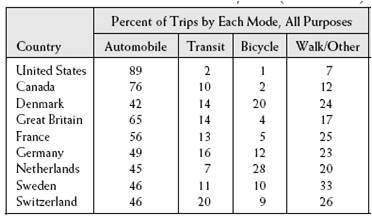
US is Behind in Reducing Car Usage

Check out this post on Krugman's blog showing the popularity of various transportation means in various industrialized countries.


It's a shame how US is behind so many industrialized countries in reducing car usage. Part of it is urban planning, but a big part of it is habit.

I wonder how much better Madison is than the US average.

There's a 50% chance the world will have to adapt to using less energy, including fewer cars. There's a 50% chance someone will develop a way to transfer nuclear power into portable high energy density storage vehicle and capture any carbon that results when the energy is released. The latter is a hard order, but people really love the perceived freedom of single-person motorized vehicles. Habits are hard to break.

Thursday, May 8, 2008

Real Estate Price "Bottom" Is Academic

You can find more eager talk about "hitting a bottom" or "what a bottom looks like" on real estate sites recently than on porno sites.

Calculated Risk analyzes the latest bottom caller in Housing: Another Day, Another WSJ Bottom Call.

The analysis is interesting, but the question is academic. Real estate prices historically track inflation. It's not like stocks. Stock prices historically grow faster than inflation. They're also more volatile and more liquid. Timing the stock market, if you could do it, could make you rich quickly. Real estate on the other hand does not give you daily price updates, is more difficult to buy and sell, and typically stays around the same inflation-adjusted price.

After the current real estate market anomaly unwinds, prices will return to historical levels, and people will think about real estate ups and downs about as much as people thought about them during the tech bubble. "Oh, real estate prices outpaced inflation by 1% this year. What do I care?"

You will know the market anomaly is over because prices will be their historical parity with rents. Real estate investors will plan to make money on their properties' cash flow rather than by speculating on price volatility.

This focus on bottoms only serves people who sell real estate or provide financing for real estate. They argue that real estate will be the engine of growth in the next economic cycle because they want to make a bailout (or series of small bailout measures) more politically palatable.

Tuesday, April 29, 2008

Fuel Costs: All Candidates Pander Except for Obama

Democrats Divided Over Gas Tax Break
Senator Hillary Rodham Clinton lined up with Senator John McCain, the presumptive Republican nominee for president, in endorsing a plan to suspend the federal excise tax on gasoline, 18.4 cents a gallon, for the summer travel season. But Senator Barack Obama, Mrs. Clinton’s Democratic rival, spoke out firmly against the proposal, saying it would save consumers little and do nothing to curtail oil consumption and imports.

While Mr. Obama’s view is shared by environmentalists and many independent energy analysts, his position allowed Mrs. Clinton to draw a contrast with her opponent in appealing to the hard-hit middle-class families and older Americans who have proven to be the bedrock of her support. She has accused Mr. Obama of being out of touch with ordinary Americans who are struggling to meet their mortgages and gas up their cars and trucks.

A gas tax holiday is blatant pandering. It encourages the very activity that is the problem: consuming fuel. If we want to offset people's increased energy costs, why not give people their $30 (estimated benefit to the average motorist) regardless of whether they use fuel?

I use a bicycle for my transportation. I can only get my $30 worth of benefit from this if I decide to go on a car trip. The more fuel you burn, the more you save.

McCain and Clinton both support a gas tax holiday, but Clinton takes it even a step further. She wants to increases taxes on oil company earnings. The problem in question is we're consuming more oil than we're extracting. Clinton's proposed solutions increase consumption and discourage oil extraction. Clinton's energy policy gimmicks couldn't be any stupider if she tried. I guess she's trying to exploit people's ambivalence in which they love the product but hate the people who provide it.

The only good thing about these pandering proposals is they won't really do much. The tax holiday wouldn't cost that much. Demand for gasoline is inelastic enough that consumption won't really increase significantly. Her proposal to tax oil companies' profits more than other companies', if somehow a significant tax increase passed, would cause oil prices to rise further and hasten the transition to other energy sources. I don't think that's the intention. She's probably proposing just a token tax, not enough really to affect after tax earnings and depress the share price.

Obama correctly identifies that we need a plan to reduce our oil use. The gimmicks are all about symbolism. Clinton and McCain using symbolism to show they're willing to pander, while Obama shows a willingness to talk about the larger problem. I do not support any candidate for president, but on this one non-issue, Obama is the only one showing the leadership I would expect from a president.

Monday, April 28, 2008

Local Moms Ask for a Play Area in the Mall

My wife and I are expecting a baby. This article caught my wife's eye.

Local Mom Petitions For East Towne Mall Play Area

What are local dads doing while their wives are petitioning for a play area in the mall? No dads were interviewed for the article.

We get commentary from mothers:
Moms like me feel it's very important for our kids to have a safe place to play and relax.
Madison is known for its parks. It's not like there aren't places you can take kids to play.

One of the biggest concerns I have regarding the safety of my baby is exposure to consumerism, especially before they're old enough to have think critically. There is no way I would consider it safe to have my child hanging out in a shopping center play area. I know my child will pick up some elements of his world view from the marketing of consumer products. It's important for me to minimize this.

Another comment from the article:
It would save me gas money because I drive to West Towne for this.
It would save even more money on gas and consumer products to visit the nearest public park instead of a shopping center.

It strikes me that one reason we created the commons, things owned by all members of society, is so we don't have to hope a private land owner creates the space we want. It's unfortunate that these petitioners feel like a private shopping center is their public commons.

The article also touched a nerve because having a baby has shown me that sexism isn't something that disappeared in the 70s. I can't imagine local dads petitioning the mall for a play area. (Info on the petition is at momsinmadison.com, not dadsinmadison.com.) People ask me how my career is going, but they don't ask me if I'm enjoying shopping for baby products. And if they did, I think it would acceptable, maybe even expected, for me to say I think most of the marketing surrounding baby products is rubbish. Expectations are different for my wife.

This is a tough issue because there's nothing inherently wrong with asking a shopping center to add a play area. There's nothing wrong with the petitioners being female. Sexism is not yet history, though, so we need to be careful what we imply in articles like this.