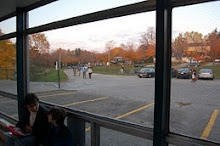
About a year ago Madison got a new bike shop. Dream Bikes is a non-profit organization that sells used bikes, provides repair services, helps teenagers prepare for professional work, and promotes bicycling. The cost of the repair services is usually about half of what I think it should be. The customer service is much better than the shop I used to use, which appeared to cater to occasional non-commuting cyclists. One amazing thing is that Dream Bikes goes to great effort to fix the parts on my bike rather than replacing them. They don’t want to run up the bill. They want to avoid waste.
It’s amazing to me that one organization does so many things. There is a map on the wall showing a two-mile radius around the store, showing how places that seem too far to reach by bike actually aren’t that far. They help needy people in the neighborhood get bicycles. I happened to be in the store once as the manager went over strategies to balance part-time work and college with a young man who may have been the first in his family to go to college.
The store is located off Verona road, a few blocks from Allied Drive. It’s tempting to call that a rough area, but that would be ignoring all the kind people at Dream Bikes who are doing good deeds every day promoting cycling and helping the community.
Saturday, February 28, 2009

Tuesday, February 10, 2009
Obama's False Dichotomy in Approaching the Economic Troubles
So, you know, we can differ on some of the particulars, but again, the question I think that the American people are asking is, do you just want government to do nothing, or do you want it to do something? If you want it to do something, then we can have a conversation. But doing nothing -- that's not an option from my perspective. --President Obama
This refrain was repeated several times in President Obama’s primetime briefing yesterday: the contrast between doing something vs nothing. The implication is that monetary policy, fiscal stimulus, bailout packages we have had so far are nothing. He didn’t say what qualifies as something. I suspect for an approach to qualify as something it has to involve in borrowing close to a trillion dollars. We can debate what we’ll do with the money, but if you don’t agree with the concept of a huge stimulus “we’re probably not going to make much progress” in negotiating a plan.
I am a supporter of Obama and the Keynesian idea of using fiscal policy (i.e. borrowing money) to level out the peaks and valleys of the economic cycle. I have even argued for a fiscal policy board to use fiscal policy the same way the Federal Reserve uses monetary policy to stabilize the economy. My perception of this stimulus, however, is that it’s analogous to the health benefits of alcohol. Alcohol, in doses of one to two ounces of liquor a day in healthy adults, has health benefits that outweigh its health costs. It’s possible that there’s a special case where a doctor might instruct someone to take three to four ounces. (I have no idea if such a special case really exists.) I feel like we’re in that situation and making plans to load up on booze and debating what kind of drinks the "ethanol therapy program" will consist of. It’s hard to choose between brandy or scotch, but it’s not hard to find the will to have a drink. If the doctor instead recommended something less pleasant (prune juice, fresh vegetables, etc), I would probably ignore the advice for the most part. That’s what’s driving this stimulus package: 10% solid Keynesian economic theory and 90% desire to live beyond our means.
Living beyond our means got us here. We need to stop as soon as possible so future hiccups don’t turn into crises. For this fiscal stimulus to work in the long-run, it needs to be followed by a debt payoff package to slow down the economy and improve our debt-to GDP-ratio.
Tuesday, February 3, 2009
Two Speculative Bubbles in a 10-Year Period
Paul Krugman was on To the Best of Our Knowledge this week talking about economics and the current troubles with the economy. He expressed concern that we have had two speculative bubbles within a short period.
54 seconds
If the dot.com bubble was foolish, the real estate bubble was foolish on steroids.
54 seconds
After the dot.com bubble burst, you would have thought that people would be quite alert to the signs of irrational exuberance out there. What happened instead was this housing bubble inflated. And it was quite clear from the numbers that something very strange was going on. How did people fall for that? It's one thing to believe that a radical new technology might create some new paradigm where old ways of measuring value didn't matter, but houses have been around for around 6000 years or so. Why would you think suddenly that old valuation models for houses were no longer relevant? And yet people bought into it. -- Paul KrugmanTo some extent I bought into the dot.com idea. I really wanted to believe that my area of expertise, technology, would change everything. It did change most everything, but it didn't change business valuation models. I can understand how people in finance and real estate might have experienced a similar psychology. What I don't understand is how they rationalized it. They didn't even have a plausible story behind it. No revolutionary development happened. Just all of a sudden they thought we were running out of places to live.
If the dot.com bubble was foolish, the real estate bubble was foolish on steroids.
Friday, January 30, 2009
Looking to Washington for Action
The workers who are returning home to tell their husbands and wives and children that they no longer have a job, and all those who live in fear that their job will be next on the cutting blocks, they need help now ... They are looking to Washington for action. --President ObamaNo they're not, if they're smart. It's fine for Washington to try to do something to help people, but if you have all these major problems, you live in fear, and you need help now; Washington isn't a reliable place to look for action. People with these financial problems need a) to look to people who are poorer and see how they survive with lower consumption, and b) to look to people who earn more to see how they do it so they don't have to use the skill of lower consumption from part "a" indefinitely.
Washington didn't create the a feeling of needing more, and it can't make it go away. It can and should do something to help people at he federal poverty line, but it doesn't have a great record of fast acting help. I have high hopes that President Obama will improve the government's record at helping the poor, but until then people in need should look to themselves, their families, their friends, vendors, and anyone else they can think of before looking to Washington.
Tuesday, January 27, 2009
Planning for the Next Expansion / Recession Cycle
There is widespread support for the government to pursue another round of borrowing to stimulate the economy. The theory is that the Federal Reserve has done all it can through monetary policy, so the only tool left is fiscal policy, in this case borrowing money. I agree that borrowing money can reduce the severity of this recession, but the price tag is too high.
The economy will continue its cycle of expansion and recession, and at some point in the next few years it will be producing more goods and services than it is today regardless of whether we do more stimulus. The question we have to ask is if we borrow a trillion dollars this year, will that help the economy in the long-run enough to justify the extra debt we will have. I suspect it will not. The main benefit from borrowing the money is to reduce the severity of the recession.
What we need in place of stimulus (i.e. gov’t borrowing) is to structure our economy to handle the ups and downs of the economic cycle. Any politician talking about dealing with this recession needs to talk about the plan for the next recession. Are we going to build a bunch of luxury items (i.e. 5000 sq ft houses or something like that) in the next expansion and then panic when the expansion turns to recession? It isn't hard to avoid this behavior and make the economic cycle be no big deal. Portugal has something like 60% of US per-capita GDP, and it’s not a constant crisis there. We ought to be set up to handle even a 10% drop in GDP without it causing major problems.
We’re like a flu patient who wants antibiotics (which aren’t effective against the flu) and who doesn’t want to hear that the best thing to do is to let the flu run its course and next year get the flu shot to keep this from happening again.
Don’t wait for politicians to do it. They're mostly operating under the idea that government must smooth out the economic cycle. The probably will not succeed in making the economy grow in a nice straight line, so people should have a plan for how they will respond to the next economic expansion or contraction.
Wednesday, January 21, 2009
I'm a Chiphead
Here's a video about electronics engineering that's actually funny.
I need three hands while I'm watching the screen: two for the mouse and keyboard, one for sipping caffeine.
Voting for the best Chiphead video contest is open until February 4.
I need three hands while I'm watching the screen: two for the mouse and keyboard, one for sipping caffeine.
Voting for the best Chiphead video contest is open until February 4.
Saturday, January 10, 2009
Michelle Singletary Says We Need a Get Away from Excessive Borrowing
Washington Post commentator Michelle Singletary was on Meet the Press just before the New Year. Here are some of her comments:
This is the first time I recall hearing on Meet the Press the idea that the solution to our crisis caused by excessive debt is not more debt. We need to hear more of this.
Trying to get back to the world of maximum consumption balanced on a wire is the wrong policy. Our goal should be that by the next time our economy cycles into recession, it has little impact on people's ability to get basic needs. The goal should not be to smooth out the economic cycle completely.
We are at a critical time. The US government has a one-time offer to borrow money at very low rates. If we don’t spend the money on things that increase structural GDP (not just things that make the recession end sooner), we will have a hard time funding the government when rates rise. For this “stimulus” to work, the borrowed money needs to be invested in things that literally change the world. The government doesn’t have a great record of excellent long-term investments, so this is a huge challenge. We should exercise moderation in any stimulus package. Otherwise if rates rise, we could see a much larger portion of our tax dollars going to service debt.
I love that [Jeff Immelt] said "reset," because--I am actually glad that we had this recession because we were on a path that we couldn't get off, and we did need that reset. We need, we needed people to step back and stop taking on so much debt and really go back to the basics. The basics are the basics because they always work no matter what the economy is. Live below your means, don't take on so much debt and save.
This is the first time I recall hearing on Meet the Press the idea that the solution to our crisis caused by excessive debt is not more debt. We need to hear more of this.
Trying to get back to the world of maximum consumption balanced on a wire is the wrong policy. Our goal should be that by the next time our economy cycles into recession, it has little impact on people's ability to get basic needs. The goal should not be to smooth out the economic cycle completely.
We are at a critical time. The US government has a one-time offer to borrow money at very low rates. If we don’t spend the money on things that increase structural GDP (not just things that make the recession end sooner), we will have a hard time funding the government when rates rise. For this “stimulus” to work, the borrowed money needs to be invested in things that literally change the world. The government doesn’t have a great record of excellent long-term investments, so this is a huge challenge. We should exercise moderation in any stimulus package. Otherwise if rates rise, we could see a much larger portion of our tax dollars going to service debt.
Subscribe to:
Posts (Atom)